Phicil-itating Change with Sheila Phicil

With years of experience in health care, most recently at Boston Medical Center (BMC), Sheila Phicil has recently switched gears, paving her own unique path to modernizing healthcare. As the former Director of Innovation for the Health Equity Accelerator at BMC, Phicil organized and interpreted patient data in order to seek ways to center patients and their unique needs.

Sheila holds a dual Master’s degree in Public Health and Financial Economics, is a Certified Project Management Professional (PMP), and a Fellow of the American College of Healthcare Executives (FACHE).

As a “social change futurist” and former “intrapeneur,” Sheila brings her unique skills to existing data collection systems by addressing racial health disparities. Like an entrepreneur, an intrapreneur is a self-led member of a larger organization, such as BMC. Through trial and error, several hospitals nationwide have adopted the same initiatives that Phicil helped onboard. She has spent the last few months sharing her expertise and guidance with healthcare facilities across the nation.

 Her hands-on, interpersonal connections with patients, caregivers, and medical professionals have led her to create a niche product of her own to advance healthcare on a global scale. 


The Woman Behind the Innovation

 As a Black woman of Haitian descent, Phicil shared how she’s witnessed the potential for science and technology to “provide the change needed for social change.” Scientific processes often help actualize the socioeconomic outcries we have experienced over countless years, quantifying them and bringing these experiences to life. With greater accessibility to education and opportunities, more people are getting a chance to enter the science field and ask meaningful questions that embody the facts of life. 

 Staying grounded amidst navigating and deciphering the minutiae of this patient data is vital. Sheila creates a balance between her work and her well-being by enjoying time in nature, soaking up the sun, and traveling. She also actively checks her perception and privilege to embrace deeper expansion and understanding of herself and the complex world around her. She is also sure to set boundaries between her work and personal life.

Life as a Social Change Futurist 

Sheila’s multifaceted venture, Phicil-itate Change is an innovation studio that brings high-potential healthcare concepts and radically patient-centered solutions to life. Following their SEEDS Framework, the team supports fellow healthcare innovators, patients, and venture studios. The innovation studio is rooted in bringing real-life solutions to everyday people that will improve the medical experience on all fronts. With countless hours of dedication and expertise applied to the project, the team is building a platform to ensure a sustainable, actionable, and effective product for both patients and healthcare providers.

While collecting data in a broad sense can be helpful, Sheila’s program will help humanize the data and numbers collected in different forms and files in healthcare offices. Providing deeper insights into each patient will allow healthcare startups to offer resources that encourage advancement and wellness for each person. The team’s flagship product, the COMPASS Project, brings these features together in an AI-powered platform. The COMPASS Project paints a clear picture of the powerful potential when innovation meets human empathy and care. 

The Inspiration Behind the Work

“Why are they in that circumstance and I’m not?” echoed through Sheila’s young mind when she saw the sad commercials of starving children back in the early 1990s. As a true community beacon, Sheila spent much of her youth organizing and working with diverse groups of people to meet common goals. She’s always found inspiration and wisdom from the guidance and collaboration with teachers, colleagues, and patients alike. Since supporting her younger siblings and honoring the ways of her parents as a young girl, Sheila Phicil has grown into a nurturing and harmonizing force, driven to bring as many people along with her towards a brighter, healthier future.

She was particularly inspired by a 10-day mission trip to Haiti in her early college days. After visiting the island to disperse medical supplies, such as wheelchairs, prosthetics, and crutches to locals in need, she discovered several discrepancies. Despite the organization’s kind-hearted efforts, speaking to the locals individually revealed unique challenges that these well-intended resources merely exacerbated. 

A majority of the locals traveled across various terrains to get supplies. Before she left, a surprising number of items were returned. Her team members were hurt and confused, but being the only Haitian-Creole speaker present helped her communicate with the locals in greater depth. These deeper, personal conversations revealed that many of the locals couldn’t use the supplies in their daily lives, so continuing without them was easier. Rather than being ungrateful or ignorant of the use of the items, the team simply didn’t supply what the locals needed. This revelation sparked a deep awakening in Sheila that has since shaped her work to facilitate greater change. 

With many active components to her work, Sheila is set to make big and lasting changes in the field of healthcare innovation. We look forward to seeing how Phicil-itate Change continues to grow and foster deeper trust in the healthcare system.

Beets, Sutures, and a New Generation of Medicine

Dasia Taylor is a young woman who began to define her career in STEM just shy of her senior graduation. Back in 2019, Dasia spent months developing a “novel suture additive” to help doctors and patients detect infection sooner. As she perfected the sutures, Dasia’s invention catapulted her across several regional and national competitions. In 2020, she landed among the top 40 finalists of the Regeneron Science Talent Search, the nation’s oldest, most notable science competition. The next stop on her journey is obtaining a patent for her novel work.

So, How Did She Do It? 

Dasia spent several months testing her sutures in beet juice. She noted that the liquid would change from bright red to dark purple, indicating a change in patient pH and likely an infection.  

But, why beet juice?  

There have been recent efforts to produce biotech sutures with a similar purpose. But with features like pairing up to smartphones, these high-tech sutures would be intricate and costly to produce. Beets are naturally more accessible and cost-effective. 

Considering healthcare needs on a global scale, biotech sutures that connect to smartphones would likely be a challenge for most people to obtain. 

With infections developing at much higher rates in countries outside of the U.S., Dasia’s invention can bring the benefits of high-tech sutures to a much wider range of people. In doing so, countless lives and billions of dollars can be saved annually by using Dasia’s beet juice and cotton blend sutures. 


All Of This at 17? What’s Next?

Since her debut in the science world, Dasia has created a local kids' science program in her home state of Iowa, inspiring younger generations of problem solvers. Growing up in a predominantly white neighborhood and navigating a predominantly white field have empowered Dasia to continue to be seen and heard. Along the way, she carefully weaves important narratives about Black history and culture into local spaces and dialogues. In her quest for knowledge, she informs others through thoughtful work and storytelling. 

In her preliminary studies, Dasia’s passion for accessible healthcare was born from her concern for the life-threatening socioeconomic and healthcare challenges facing women throughout Africa, in particular. Naturally, her equitable nature is intended to improve healthcare globally, for all people.   

Education and equitability are at the heart of her passionate strides toward accessible healthcare for those who need it most. Dasia is nothing short of phenomenal, as she works toward getting a patent, she continues to bring her community along with her. We look forward to seeing more of Dasia Taylor’s journey as she breaks barriers in STEM. 


Reviving a Timeless Science with PhagePro

PhagePro was born out of a deep knowledge of science and an even deeper passion for helping others. Co-founded by Dr. Minmin Yen in 2016, PhagePro has grown as a pioneer in eradicating deadly global diseases. As a first-generation Taiwanese-American, Dr. Yen takes great pride in honoring her heritage and improving the lives of others alongside her passionate colleagues. 

Dr. Yen remains inspired and empowered by fellow women and people of color who break barriers simply by existing. Her efforts are also fueled by passionate supporters who understand and trust in the great potential of this living science. 

Dr. Minmin Yen and the Birth of PhagePro

Dr. Yen and her co-founder, Professor Andrew Camilli during a group dinner with their collaborator our collaborator in Dhaka, Dr. Munirul Alam, and associates.

Dr. Yen grew up in a loving, determined, and courageous family. Her mother and father left Taiwan for the United States in the 1970s. Together, they were committed to paving the way for their growing family through education.

While her mother was a history major, her father was fueled by a natural inclination toward  STEM concepts and their application in daily life.  Their father encouraged the Yen girls to follow their own wonders to discover the inner workings of the world around them.

Featured: In the yellow hijab is PhagePro collaborator, Dr. Marzia Sultana from the International Centre for Diarrheal Diseases in Bangladesh. We also see Dr. Fatema Tuz-Johura, a Research Associate at Johns Hopkins, and Dr. Yen.

Combining her passion for helping people with the possibilities of science, Dr. Yen has embarked on her journey in the medical field, bringing PhagePro to life.

Since its founding in 2016, PhagePro has been committed to ending the cholera epidemic. Most of the active cases of cholera occur in countries with limited resources. Able to kill a person within 12 hours of initial symptoms, cholera is a high priority for global health organizations. The team has since partnered with organizations in Dhaka, Bangladesh as they prepare for the first trials of this cutting-edge treatment. 

Backed by a team of fellow experts in medicine and healthcare, PhagePro is unearthing the modern-day potential of a century-old wellness practice using phages. 

So, What Exactly are Phages? 

The science behind phages can help medical professionals move towards eradicating bacterial diseases such as cholera. Phages are viruses that target and eliminate specific pathogens, reducing the risk of long-term side effects and disease mutations.

Phages are naturally occurring and abundant on land, in the water, and even in our bodies. There are a variety of phages, working with both good and bad bacteria throughout nature. When phages target bad bacteria, they seek to eliminate the infection completely, making them a strong contender for the next antibiotic revolution. 

Unfortunately, some experts speculate that phages are too archaic to be reliable. However, their modern-day successor, antibiotics, are rapidly outdating themselves. Once the powerful nature of phages can be harnessed, there is great potential for these little fighters to support PhagePro's quest for global wellness. 

Revolutionizing Antibiotics

Modern-day antibiotics are great at killing all bacteria, good and bad. However, many patients become susceptible to even more bad bacteria overpowering their system if they cannot recover in time. Incomplete antibiotic treatments also create a breeding ground for bad bacteria to mutate and resist the treatment altogether. With many bacterial diseases rapidly mutating, it is clear that a new and lasting solution is desperately needed for treating infectious diseases.

Phages can target the bad bacteria specifically and they are specific to the bacteria they attack. For example, imagine someone who needs a cholera treatment, their phage dosage will only target the pathogens that are causing harm. By targeting the problem directly, phages minimize the risk of adverse reactions. They can also be used to treat other bacterial infections, such as STDs, UTIs, meningitis, staph infections, and pneumonia.

Once the infection is gone, the phages are simply flushed out of our systems. Having an abundant, natural supply of phages also implies that there will be no worry about shortages. It will likely also appeal to more people because it is naturally occurring and straightforward in its action. Treatment is rapid and symptoms begin to alleviate within moments of application, decreasing the further spread of the disease.

With the rise of antibiotic resistance in humans, animals, and plants, there has to be a different way to address bacterial pathogens more effectively. While phages were discovered about 100 years ago, coupling this practice with current scientific advancements will bring nothing short of monumental change. If we can reduce the spread of disease… imagine how much more we can invest into creating a brighter future for us all.


Mbadika: Meet Netia McCray and Her Limitless World of Ideas

Netia McCray grew up watching her parents make their dreams become reality. Her mother and father were scientists in their own right, demonstrating a particular knack for creation and production. 

Netia’s mother was a seamstress, demonstrating design development with her unique fashion creations for family and community members alike. Her mother would also spend her spare time teaching others how to nurture their own entrepreneurial spirits. 

Netia’s father was a mechanical engineer, working on cars and spending much of his time tinkering away at old gadgets and gizmos.

At the end of her junior year in high school, Netia was invited to check out MIT’s summer enrichment program, MITES (Minority Introduction to Engineering and Science). After aspiring to attend the school himself, her father fervently suggested that she attend the program. Unsure of what MIT had to offer, Netia was initially skeptical, assuming she’d be forced to learn nuclear physics. 

Once she reached the Cambridge campus, Netia was pleasantly surprised by MIT’s vast scientific opportunities, unveiling a rich world of potential. Netia was exposed to a unique network of STEM (science, technology, engineering, and math) disciplines, unraveling the mystery of science into something more digestible. Blown away by the fullness of STEM, Netia eagerly participated in the program and earned herself a full ride to the school as an undergraduate, making her family proud. 

Despite facing personal and social hardships, Netia was determined and graduated from MIT with a desire to bring her newfound passion to young students like her. She has been on a mission to demystify the world of science and open the doors of opportunity to more students of color ever since.

Shortly after graduating, Netia launched her company Mbadika, (bah-GEEe-kah), focusing on providing local Boston high school students with paid STEM internships. The internship program not only allowed the students to explore the sciences, but they also had a hand in developing some of the later programming for Mbadika. The first cohort of students contributed to the design and production of the MLAB field kits, which continue to inspire fellow explorers ages 8 and up.  Mbadika also recently launched a public workshop initiative, MLAB, to provide the general public access to STEM education in informal settings such as local shopping centers. Featured in a pop-up at the Cambridgeside Galleria, these biweekly workshops offered students and newcomers a taste of STEM by exploring the science of fashion or how to recreate items from popular films. 

Both the workshop and internship aim to bring various STEM concepts and practices such as design development, 3D Printing, digital content creation, and more. Netia has been able to present complex topics and ideas in a relatable and engaging way. In this way, Netia has successfully been able to empower people from all walks of life to take risks, be bold, and realize their innate ability to understand STEM. 

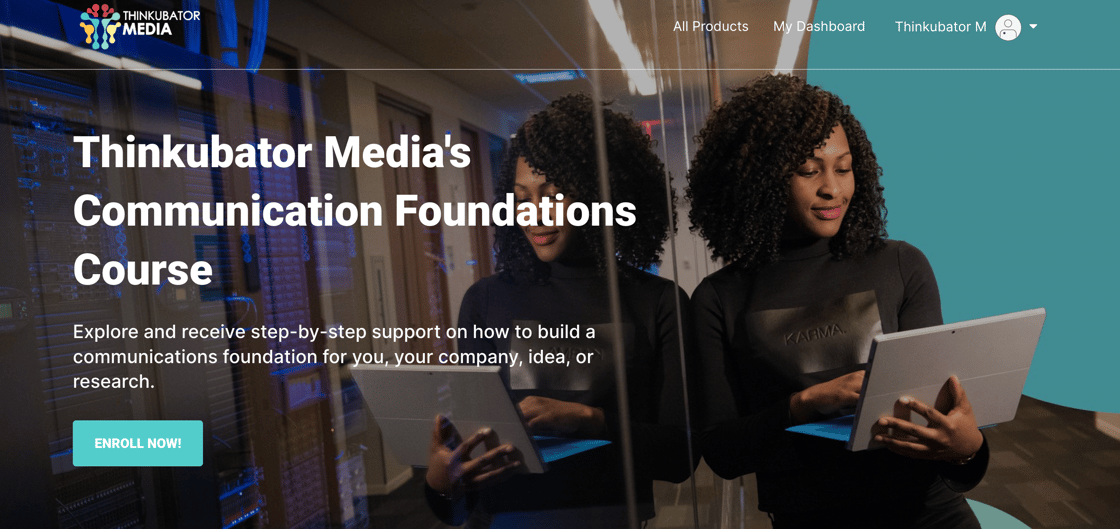
Communications Foundations Online Course

Thinkubator Media is proud to present our online learning platform. Below is our inaugural course: Thinkubator Media's Communication Foundations Course.

With this course, you'll receive step-by-step support on how to build a communications foundation for you, your company, idea, or research.

What to Expect
In this course, you will gain the knowledge and understanding of the basic communication skills needed to build your own communications roadmap for your company.

What We'll Cover
In this introductory course, we'll cover the following topics:

What You'll Learn
By the end of this course, you'll be able to:

ENROLL NOW!

Thinkubator Media Presents to Mass NextGen Founders

Thinkubator Media founder and CEO Lori Lennon was invited to present a workshop to founders of the Massachusetts Next Generation Initiative (Mass Next Gen), a program within the Massachusetts Life Sciences Center (MLSC) organization. The goal of this January session was to guide founders on how to create engaging stories and messages to reach their growing audience. 

“I’m grateful for the opportunity to share our company’s knowledge of messaging and storytelling with Mass Next Gen founders,” said Lennon. “Effective messaging in the sciences can make or break an idea. These founders now have more resources in their toolbox to grow and thrive.”

MLSC is a Massachusetts-based group dedicated to the economic and organizational growth of Massachusetts-based life science organizations.  The team at MLSC heavily prioritizes innovative ventures and development in the various fields of biotechnology, including biopharma, medical devices, diagnostics, and digital health. MLSC makes it possible for up-and-coming biotech companies to access the necessary resources to sustain and empower their endeavors. 

Mass NextGen’s mission is to empower the next generation of life scientists by leveling the playing field for women. Mass NextGen is working on expanding its program to reach more women entrepreneurs in life sciences. 

In their first four years alone, Mass NextGen allocated $2 million in funding to women entrepreneurs, along with 200+ hours of coaching services. Mass NextGen is helping jump-start the future of science by investing in young and curious women. 

MLSC has remained steadfast in upholding future generations of Massachusetts-based biotech science initiatives. Since 2007, the organization has played an integral role in supporting local research, and commercialization of technology, along with successful business implementation and expansion initiatives.

MLSC and Mass NextGen continue to expand their reach across the state. If you would like to learn how to get involved, visit their website here.

The Problem Thinkubator Media is Trying to Solve

Want to learn more about Thinkubator Media and what we do? Visit our YouTube Shorts page to learn more about our story, the problem we're trying to solve, and a sneak peek at what you can expect from Thinkubator Media in the near future.

VIDEO: The Thinkubator Media Difference

Thinkubator Media is proud of its work and highlights here how its methodology is different.